

PM in text almost always means “private message.” When someone writes “PM me,” they are asking you to send them a message privately instead of replying in a public thread, comment section, or group chat.
The same two letters can also mean “post meridiem” (the hours after noon), “project manager,” and in news and politics “prime minister.” This guide explains each meaning, how PM compares with DM, and when using it makes sense.
What Does PM Mean in Text?
In text and online chat, PM stands for private message: a message that only the sender and the recipient can normally see. It works as a noun (“I sent you a PM”) and as a verb (“I’ll PM you the details”).
People reach for it when a topic is too personal, too detailed, or too off-topic for a public conversation, such as sharing contact details or arranging a sale.
PM meaning in Chat from a girl

The meaning does not change with the sender’s gender. A girl who writes “PM me” is asking for a private conversation, exactly as anyone else would.
What changes the feel is context. Between friends it is usually practical, in a marketplace it is business, and in a flirty exchange it may signal interest. Read the tone and the relationship rather than assuming.
PM Meaning in Very Simple Words
PM means “message me privately.” Think of it as passing a note instead of announcing something to the whole room.
A quick test: if the sentence is about sending, checking, or replying, PM means private message. If a number comes right before it, as in “6 PM,” it is a time.
Breaking Down the Term “Private Message”
A private message is a one-to-one (sometimes small-group) message delivered inside a platform such as a forum, Facebook, or Reddit rather than posted on a public wall or thread. “Private” means other users cannot see it, not that it is encrypted or guaranteed to stay secret.
PM is the older term and is commonly traced to early forums and message boards. Many platforms now label the feature Message, Chat, or Inbox, but people still say PM out of habit.
Other Meanings of PM (Context-Based)
Context decides which meaning applies. The surrounding words, the platform, and who is writing usually make it obvious.
| Meaning | Where You See It | Example |
| Private message | Chats, forums, social media | “PM me your email.” |
| Post meridiem | Times and schedules | “Dinner is at 7 PM.” |
| Project manager | Workplaces | “Ask the PM for the deadline.” |
| Prime minister | News and politics | “The PM addressed parliament.” |
| Personal message | Informal variant of private message | “Send me a PM.” |
When two meanings could fit, ask. A one-line clarification is faster than guessing wrong.
Why People Use PM in Text Messages
The first reason is speed: two letters replace a whole sentence. The second is privacy, since phone numbers, addresses, and other personal details do not belong in a public thread.
It also signals a shift in the conversation. The topic is moving from public to one-on-one, which keeps shared threads clean.
How PM Is Used in Daily Conversations
PM appears in a few predictable patterns, and each one points back to the same idea of private messaging.
- “PM me the address.” A request to send details privately.
- “I’ll PM you later.” A promise to message one-to-one.
- “Check your PMs.” A reminder that a private message is waiting.
- “Sent you a PM.” A confirmation that the message has gone out.
What does PM mean in time
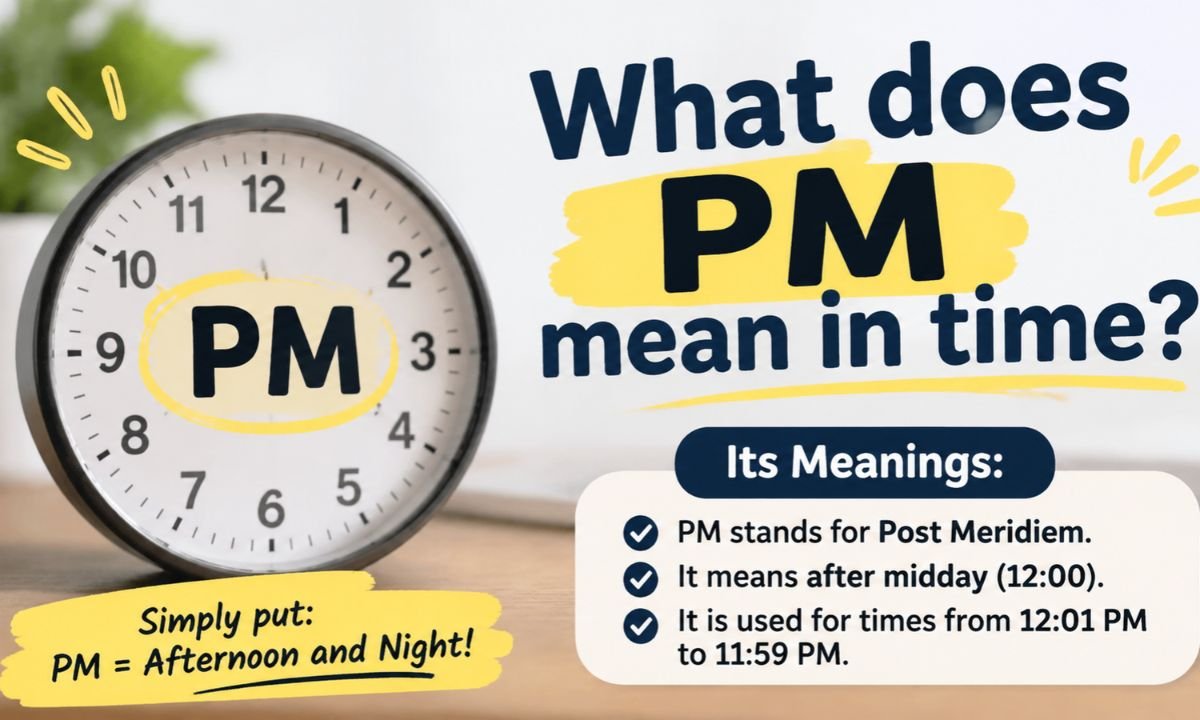
In time, PM is short for the Latin post meridiem, meaning “after midday.” It covers the hours from 12:00 noon until 11:59 at night, while its counterpart AM (ante meridiem) covers the hours before noon.
In the 12-hour system, noon is 12 PM and midnight is 12 AM. If a number sits before PM, such as “meet at 6 PM,” it is a time and has nothing to do with messaging.
PM in Different Situations
The meaning of PM stays stable, but its tone shifts by setting: casual with friends, transactional in marketplaces, and more careful at work.
Before replying, check three things: the platform, your relationship with the sender, and what was said just before PM appeared.
PM in Messages
Ordinary text messages are already one-to-one, so “PM me” is more common in public or group settings than in a direct SMS thread. In a group chat it moves a side topic to one person.
If someone sends “PM me” inside a private text, they may want to continue on another app, or it may just be habit. Ask if it is unclear.
Also Read This:HYB Meaning in Text: What Does HYB Mean in Texting and How to Use It?
PM in Social Media Platforms
On Facebook, PM is a common informal way to say “send me a Messenger message,” especially in groups and Marketplace. Forums and Reddit also still use it, while Instagram, X, and TikTok lean toward DM.
Platform labels vary, but the request is the same. Look for the Message, Chat, or Inbox button on the person’s profile.
PM vs DM (Difference Explained in Detail)
In practice, PM and DM mean the same thing: a private, non-public message. The difference is mostly history and platform habit, with PM rooted in forums and DM tied to newer social apps.
| Term | Stands For | Commonly Seen On |
| PM | Private message | Forums, Reddit, Facebook |
| DM | Direct message | Instagram, X, TikTok |
Either request gets the same response, so there is no need to correct anyone who uses the other term.
PM in Personal Chats
With friends and family, “PM me” is usually practical or private: sharing plans, a phone number, or news that is not for everyone. The tone is relaxed.
A short reply is enough, either the message itself or a quick “sent.” If you are unsure what the person wants, ask.
PM in Group Chats
In a group chat, “PM me” redirects a side conversation to one person so everyone else is not scrolling past details that only one person needs.
Use it for information that really is individual. Overusing it can make a group feel like decisions are being made behind closed doors.
PM in Online Marketplaces
Sellers often write “PM for price” or “PM me to arrange pickup” so offers, availability, and meeting details stay between buyer and seller. It is especially common on Facebook Marketplace and community selling groups.
Stay cautious with anyone who pushes you to leave the platform quickly or pay in unusual ways. Never send payment credentials through a message.
Pm meaning in office

At work, PM usually means project manager, the person responsible for planning and delivery. It is sometimes used for product manager too. “Loop in the PM” refers to a person, not a message.
In tools such as Slack or Teams, “PM me” can still mean private message. Check whether the sentence points to a person, a time, or an action.
PM in Professional Communication
In formal emails, spell it out. “Please message me directly” cannot be misread, while a bare “PM” might be taken as project manager or a time.
Use PM as shorthand only with colleagues who already use it, and keep important decisions in shared channels or email so there is a visible record.
Advantages of Using PM
When used well, PM makes conversations simpler and more focused.
- It is quick to type and widely understood on forums and social platforms.
- It keeps personal details out of public view.
- It reduces clutter in group threads and comment sections.
- It lets one person get a detailed answer without distracting everyone else.
Disadvantages of Using PM
The shorthand has limits, and most problems come from ambiguity or false assumptions about privacy.
- It can be confused with a time or with project manager.
- It can sound informal or secretive in the wrong setting.
- Private does not mean confidential, since recipients can share or screenshot messages.
- It can encourage oversharing with people you do not know well.
When Should You Use PM in Text?
Use PM in casual, low-stakes situations where the other person is likely to understand it. Good fits include:
- Forums, Reddit, and Facebook groups
- Marketplace listings and community selling groups
- Group chats when a detail only concerns one person
- Conversations with friends who use the same shorthand
When You Should Not Use PM
Avoid PM when clarity or professionalism matters more than speed.
- Formal emails and messages to managers or clients
- Any message that also mentions times or project roles, where it could be misread
- Requests for sensitive information such as passwords or financial details
- First contact with someone who may not know the term
How to Reply When Someone Says PM
If you are happy to continue privately, send the message and, if the request was public, acknowledge it briefly so they know to look. Short replies work well:
- “Sent, check your inbox.”
- “Sure, what do you need?”
- “Messaged you just now.”
If you are not comfortable, you can answer publicly or decline politely. You are never obliged to move a conversation into private messages.
Common Mistakes When Using PM
The most common mistake is using it in formal writing, where it may be read as project manager or a time. Another is assuming everyone knows the term, since some people only use DM.
People also treat a PM as fully secret and share sensitive details they would not post publicly, or they ask for a PM and then never follow up.
PM and Privacy in Digital Communication
A PM is hidden from other users, but it is not guaranteed confidential. The recipient can screenshot or forward it, platforms set their own rules for storing and reviewing messages, and accounts can be compromised.
Treat PMs as semi-private. Avoid sending passwords, full card numbers, or government ID details through them.
PM and Communication Efficiency

Moving a detail into a PM sends it straight to the person who needs it. Everyone else reads less, and the right person responds faster.
It works best when the request is specific. “PM me your order number” gets a useful reply, while a vague “PM me” usually starts with a round of questions.
How PM Improves Conversation Flow
Public threads stay on topic when side details, such as addresses or schedules, move elsewhere. Readers can follow the main discussion without wading through logistics.
Once the matter is settled privately, a short public note like “sorted via PM” closes the loop so others know the question was answered.
PM in Online Communities and Forums
Forums are where the term became familiar. Many have an inbox that lets members message each other without posting in public, and “PM me” is still the natural phrase there.
Read the community rules first. Some communities limit unsolicited PMs or restrict messaging for new accounts, and breaking those rules can get you flagged.
PM and Trust Building
A polite, clear PM can build rapport because it gives one person your full attention, which suits sensitive questions or personal follow-ups.
Trust works in both directions. A PM that explains who you are and why you are writing is far more welcome than an unexpected message with no context, and unexpected requests for money or personal details deserve caution.
Why PM Feels More Personal
A message addressed only to you feels like direct attention. There is no audience, so people tend to be more relaxed and candid than they would be in public.
That sense of closeness is why some people read PM as intimate. It is not inherently romantic, and most PMs are simply practical.
PM in Customer Support
Brands often ask customers to send a PM (or DM) with order numbers, emails, or account details so that personal information stays out of public comments.
Make sure you are messaging the brand’s official account. Impersonator accounts sometimes reply to public complaints and invite people to “PM” them.
PM in Gaming and Online Interaction

Gamers use private messages for team coordination, trading, and sending invites on platforms such as Discord, away from the public lobby or server channel.
Unsolicited PMs from strangers can be spam or harassment. Use block and report tools rather than engaging.
PM and Digital Etiquette
Introduce yourself, state your reason, and keep the message short. Do not repeatedly message someone who has not replied, and do not PM people who have not invited contact for something they are unlikely to want.
Never post someone’s private message publicly without their permission. A PM was written for one reader.
How PM Reflects Modern Communication Trends
PM reflects a wider move from public posting toward private, one-to-one conversation, along with the habit of shortening phrases into abbreviations for speed.
It is also a reminder that online language shifts by platform. DM has become the more common term on newer social apps, while PM stays strong on forums and Facebook.
See Also:
- DM meaning in text, chat, and social media
- PMO meaning in text and business
- IDGAF meaning in text
Frequently Asked questions
Does PM always mean private message?
No. It can also mean post meridiem (after noon), project manager, or prime minister, so check the surrounding words.
Is PM the same as DM?
Yes, in practice. PM is more common on forums, Reddit, and Facebook, while DM is more common on Instagram, X, and TikTok.
Is a PM really private?
Other users cannot see it, but the recipient can screenshot or forward it, and platforms have their own policies. Avoid sharing passwords or financial details.
How do I send a PM?
Open the person’s profile and look for a Message, Chat, or Inbox button. The exact label depends on the platform.
Can I use PM in a work email?
It is better not to, since it could be read as project manager or a time. Write “message me directly” instead.
Conclusion
In text, PM means private message, and “PM me” is a request to continue the conversation one-to-one. Time, project manager, and prime minister are the other meanings to watch for, and context almost always makes the right one clear.
Use PM in casual settings with people who understand it, spell it out in formal writing, and remember that private does not mean confidential.