
In text messages and social media, ION usually means “I don’t.” It spells how “I don’t” sounds when said fast, so “ion know” means “I don’t know” and “ion care” means “I don’t care.”
In capitals, ION can also stand for “in other news,” and in science an ion is a charged particle. This guide separates each meaning, shows examples, and explains when the slang fits.
What does ION mean in text?
In text, ION means “I don’t.” It sits where “I don’t” would go, so a verb follows: “ion wanna go” is “I don’t want to go.”
Dictionary.com calls it a spelling of the casual pronunciation of “I don’t,” especially in Black English. Guides disagree on which meaning is primary, but slang references list “I don’t” for the lowercase form.
What does ion mean in text from a girl
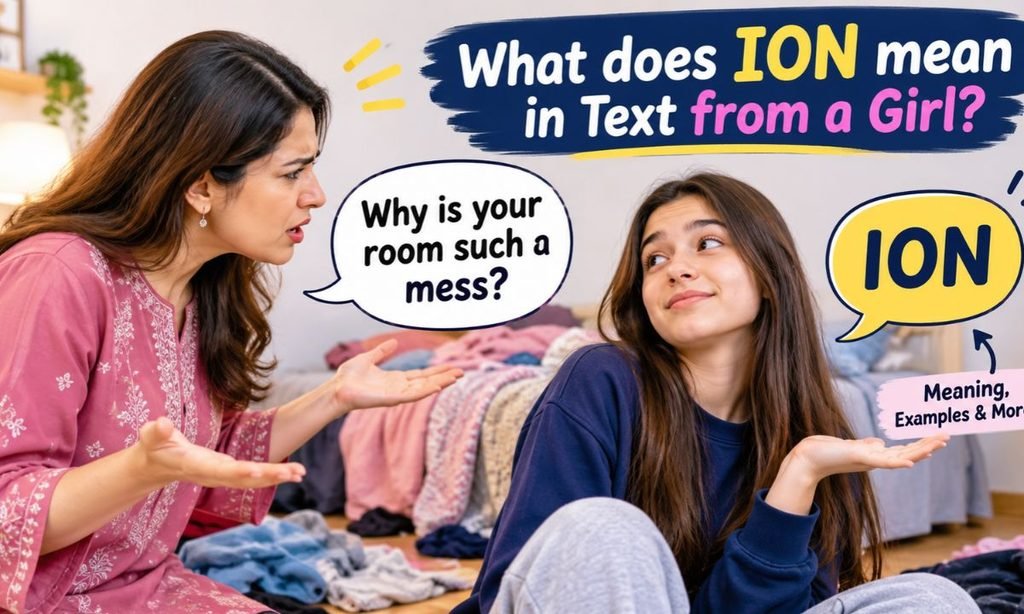
The sender’s gender does not change the meaning. When a girl texts “ion know,” she means “I don’t know,” as guides that address this question confirm.
Tone depends on the rest of the message. “ion know lol” sounds relaxed, while a bare “ion care” can sound cold, so check punctuation, emojis, and the earlier messages.
ION full form and definition
As “I don’t,” ion is a respelling, not a true acronym. It drops the apostrophe and the space, as Slang.net explains.
The same letters carry other meanings, so the form and context matter.
| Written as | Stands for | Type |
| ion (before a verb) | I don’t | Slang respelling |
| ION (capitals) | In other news | Topic-change acronym |
| ion (science) | Charged atom or molecule | Standard word |
Is ION rude, offensive, or neutral?
ION is neutral. It has no profanity and is not an insult, so it is not offensive on its own.
Tone comes from what follows. “ion know” signals mild uncertainty, while “ion care” is plain indifference and can sound blunt, as “I don’t care” does. Slang.net notes it can also add humor, disbelief, or defiance.
Where is ION commonly used?
ION appears in text messages, DMs, comments, captions, and group chats. Slang.net links its popularity to Twitter, TikTok, and Instagram, and it has reached music, such as Moneybagg Yo’s 2018 song “Ion Get You.”
It is rare in edited writing like news, essays, and business email, where the full phrase is expected.
Why people use ION slang
Speed and sound drive it. Three letters beat “I don’t,” and the spelling matches how many people say the phrase aloud.
It also sets a relaxed tone and signals comfort with internet language, much as an emoji adds feeling to a plain sentence.
What does ion mean in Chemistry

In chemistry, an ion is an atom or molecule with an electric charge, formed when it gains or loses electrons. A positive ion is a cation and a negative ion is an anion.
Dictionary.com traces the term to Michael Faraday’s work in 1834 and a Greek word for “going.” Words like charge, electron, or battery nearby signal science, not slang.
Real-life examples of ION usage
These patterns cover most everyday use of the slang.
| Text | Meaning |
| ion know | I don’t know |
| ion care | I don’t care |
| ion think so | I don’t think so |
| ion even like that | I don’t even like that |
ION only replaces “I don’t.” It does not stand for “I can’t” or “I won’t.”
Origin and background of ION slang
Dictionary.com says “ion” for “I don’t” emerges in internet writing in the 2000s, rooted in Black English pronunciation. Its 2018 entry shows the spelling spreading on Twitter that year.
Slang.net places peak popularity in the late 2010s and early 2020s. A first recorded use is not documented in the sources reviewed, so exact dates remain uncertain.
ION meaning slang vs traditional meaning
The traditional dictionary meaning is the charged particle. The slang meanings are informal, and Dictionary.com says its slang entry is not a formal definition.
| Meaning | Clue | Example |
| I don’t | Lowercase, before a verb | ion know |
| In other news | Capitals, starts a new topic | ION, new haircut |
| Charged particle | Science words nearby | a positive ion |
Comparison with similar slang terms
IDK, IDC, and IDGAF are complete phrases, while ION replaces only two words and needs a verb after it.
Intensity also differs. IDGAF is the bluntest, while ION takes its force from the words that follow.
| Term | Stands for | Tone |
| ION | I don’t | Casual, varies |
| IDK | I don’t know | Neutral |
| IDC | I don’t care | Casual, softer |
| IDGAF | I don’t give a f*** | Strong, blunt |
Similar meanings and related slang
ION combines with other words in repeatable patterns, and the same trick works for “I don’t” in longer messages.
- “ion wanna” means “I don’t want to”
- “ion even” means “I don’t even”
- “ion know” works like IDK
A few low-quality pages list “it’s on now” or “in our nation,” but dictionary and glossary sources do not, so treat those as unverified.
When should you avoid using ION
Skip ION wherever clarity or formality matters. It can confuse readers who do not know the slang.
- Work emails and professional chats
- School essays and formal writing
- Public posts where “in other news” could be read instead
When unsure about your audience, write “I don’t.”
What does ion mean on a fan
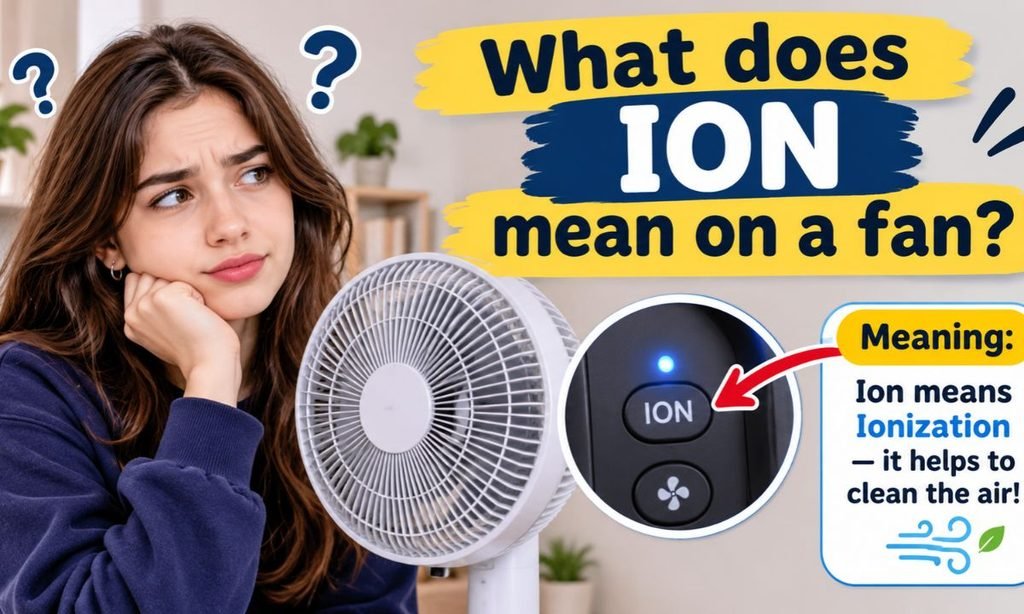
On a fan, “ion” usually labels an ionizer function, sometimes called anion, that releases negatively charged particles into the airflow. Healthline notes some fans include an ionizing setting.
Marketing often claims cleaner air and better mood. A study summary on Wikipedia reports no consistent influence on anxiety, mood, relaxation, or sleep, so treat those claims cautiously.
Also Read This:What Does IKTR Mean in Text? Meaning, Examples & Usage
Polite alternatives to ION
Neutral wording keeps the same meaning in mixed company.
- “I don’t know”
- “I’m not sure”
- “Not really”
- “That doesn’t work for me”
For work or school, “I do not” or “I don’t” is the safest choice.
Impact of slang in communication
Slang like ION speeds up chat and builds belonging. The cost is misreading: Dictionary.com’s entry includes a reader who saw only the science term.
Switching between casual and formal wording, called code-switching, solves most problems. Match your language to your audience.
Is ION safe for social media?
Yes. ION is mild, has no profanity, and carries no known harmful meaning, so it suits captions, comments, and DMs.
The risk is clarity, not safety. A brand or public account with a mixed audience may be misread, so write “I don’t” when the message must be unmistakable.
Regional & Cultural Usage of “ION”
Dictionary.com ties the “I don’t” sense to Black English, and the spelling spread through social media and rap lyrics. Slang.net gives the pronunciation as “i-own.”
The sources reviewed do not break usage down by country or region, so claims about regional patterns are unverified.
Examples of ION in conversations
These short exchanges show both slang meanings in context.
- Friend: “Where should we eat?” You: “ion know, you pick.”
- Friend: “Coming tonight?” You: “ion think so, I’m tired.”
- Post: “ION, anyone watching the game?” (in other news)
The capitalized post changes the topic, while the lowercase replies mean “I don’t.”
What is ion in social media?
On Twitter, Instagram, and TikTok, lowercase ion in a caption or comment almost always means “I don’t.” Dictionary.com cites a 2018 tweet about wanting only to win, not to compete.
Capital ION at the start of a post usually signals a topic change, much like “anyways,” according to Dictionary.com.
Frequently Asked Questions
Does ION always mean “I don’t”?
No. In capitals it can mean “in other news,” and in science it names a charged particle.
How do you pronounce ION slang?
It sounds like “eye-own,” the same as the science word, matching “I don’t” said quickly.
Is ION the same as IDK?
Not exactly. IDK is a complete phrase, while ION replaces only “I don’t,” so “ion know” equals IDK.
How do you reply to “ion know”?
Treat it as “I don’t know” and offer an option or ask a simpler question.
Can you use ION in formal writing?
No. Write “I do not” or “I don’t” in professional, academic, and other formal contexts.
Conclusion
ION most often means “I don’t,” a casual spelling that rose through Black English, social media, and music. Capital ION can mean “in other news,” and the science and fan meanings depend on nearby words.
Read the context, match your wording to the audience, and use the full phrase when clarity matters.